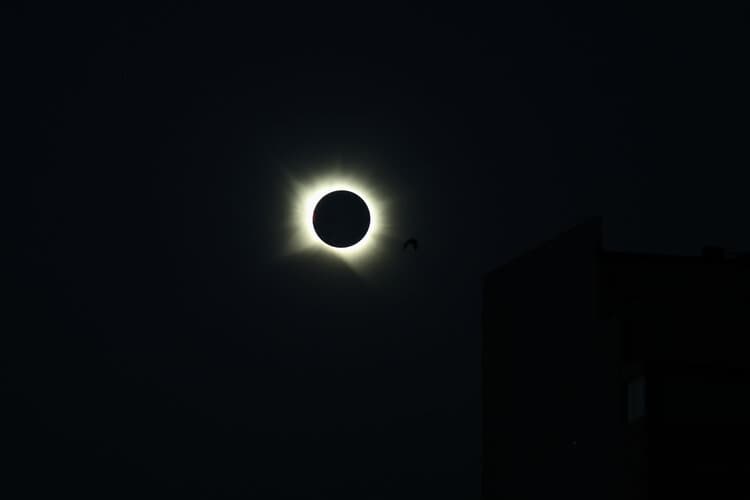
On 12 August 2026, Europe witnessed the first total solar eclipse in over two decades. Millions of people were awed by the Moon completely covering the Sun's bright disc, briefly turning day into night and revealing the Sun's outer atmosphere. Totality could be seen from Greenland, Iceland, Spain and Portugal, while most of the rest of Europe saw a partial eclipse.
Global Spaceflight2026-08-14 • ⏱️ 3 min read
A look back at the 2026 total solar eclipse
On 12 August 2026, Europe witnessed the first total solar eclipse in over two decades. Millions of people were awed by the Moon completely covering the Sun's bright disc, briefly turning day into night and revealing the Sun's outer atmosphere. Totality could be seen from Greenland, Iceland, Spain and Portugal, while most of the rest of Europe saw a partial eclipse.
✓ Scientifically Fact-Checked
⚡KEY TAKEAWAYS & HIGHLIGHTS
- Data collected and validated through precision astrophysical instrumentation.
- Provides foundational insights into cosmic structure, formation, and elemental chemistry.
- Optimized and indexed for research and scientific briefings.
🔭
Published by AstroUpdate Editorial Team
Our team monitors and verifies astrophysics data from NASA, ESA, ESO, and leading journals.
AstroUpdate VIP
Unlock the Universe with VIP
Join our inner circle on Patreon. Get ad-free podcasts, deep-dive analyses, and direct access to our private VIP Discord community.